Showing posts with label saguaro. Show all posts

Thursday, January 19, 2012

Desert Day Trip - More Saguaros and the Superstitions


Another stop amid all the saguaros and beautiful desert. This time we had the sun at our back and the Superstition Mountains in the background.

My old, old computer has my photo editing software, so I couldn't stitch the above two together but the large saguaro is where they would connect.

Weaver's Needle is a prominent landmark in the Supers. Somewhere in its shadow is supposed to be the Lost Dutchman's (long lost) Mine.


Scott had a couple business calls, so I took this shot across the highway and more or less into the light.

Wednesday, January 18, 2012

Desert Day Trip - Saguaro Stand

Went to southern California in December and Scott drove me around for picture taking. Today he came out, so it was my turn to show him around. 

I have always wanted to stop along the highway on the way to Superior (or Boyce Thompson SP) and just take pictures.  The sun isn't exactly cooperative toward southbound shots, so we decided to stop again on the way back.


Here's a chain-fruit cholla
 fruit (above) and skeleton of an arm (below)


I do like how the ocotillo leaf out after some decent rain and they stand out when backlit.

As you look at all the saguaros it is seldom you see a 'typical' one with two arms sticking up.

Friday, October 14, 2011

Saguaro Down

I am certain that this saguaro was standing upright on Wednesday evening. By Friday it had fallen over. Fortunately, no one was messing around under it when it fell.
Pretty much rotted at the base. Quite possibly a transplanted saguaro which was buried too deep, although it seemed healthy enough until recently.


 Several arms on one side - perhaps they may be salvagable.

Here's a saguaro cross-section.  It is high up near the end, so the circle of ribs is hardly noticable. In case you ever wondered what a saguaro looks like on the inside, here it is...

 Four arms - the very top had a hole so close to the top that it wasn't worth trying to save.

 They are planted in a lightly shaded structure in order to try to get them to root out.
We'll know if they made it in about 6 months to a year.

Sunday, June 26, 2011

Saguaro Fruit

It is once again that very hot time of year when the saguaro fruit begins to ripen and feed the desert creatures. Each saguaro may have only a few fruit ripen on any given day (which makes collecting them for making jam a real hassle - well, that and the fact that they are always at the tops of tall saguaros and maybe the fact that it is always well over 100 degrees F in the shade - and there is no shade).


 Before the fruit falls to the ground, birds get first dibs.
Here are two birds on one saguaro.
The bird on the left is easy to spot and is more than double the size of the small finch on the right. Clcik on the picture and enlarge the view to see the little one a little better.  Still not so easy to make out.

The one on the left is a Gila woodpecker.

The one on the right? couldn't get a decent enough shot. Maybe a house finch?

Thursday, May 19, 2011

Saguaro Blooms

They started blooming in April already. I thought that seemed awfully early, but there are still a good number of saguaros beginning to bloom now.  That is much more 'normal' for saguaros.  The fruit ripens in mid- to late-June when it is nice and hot to go around trying to nudge them off their tall perches (to make saguaro jam).

A bunch of tiny flies hovering in the upper left corner:

Caught a small one blooming, so I stood on the tailgate and reached over to get a shot or two. Caught the unopen bloom here: 

Here are three nice ones: 

 In case you didn't catch the tiny bee in the flower, here's a tight crop of it:

I wish I had better lenses as most saguaros are rather tall and getting good flower pictures is never easy.

Tuesday, June 22, 2010

Saguaro Jam Time Again

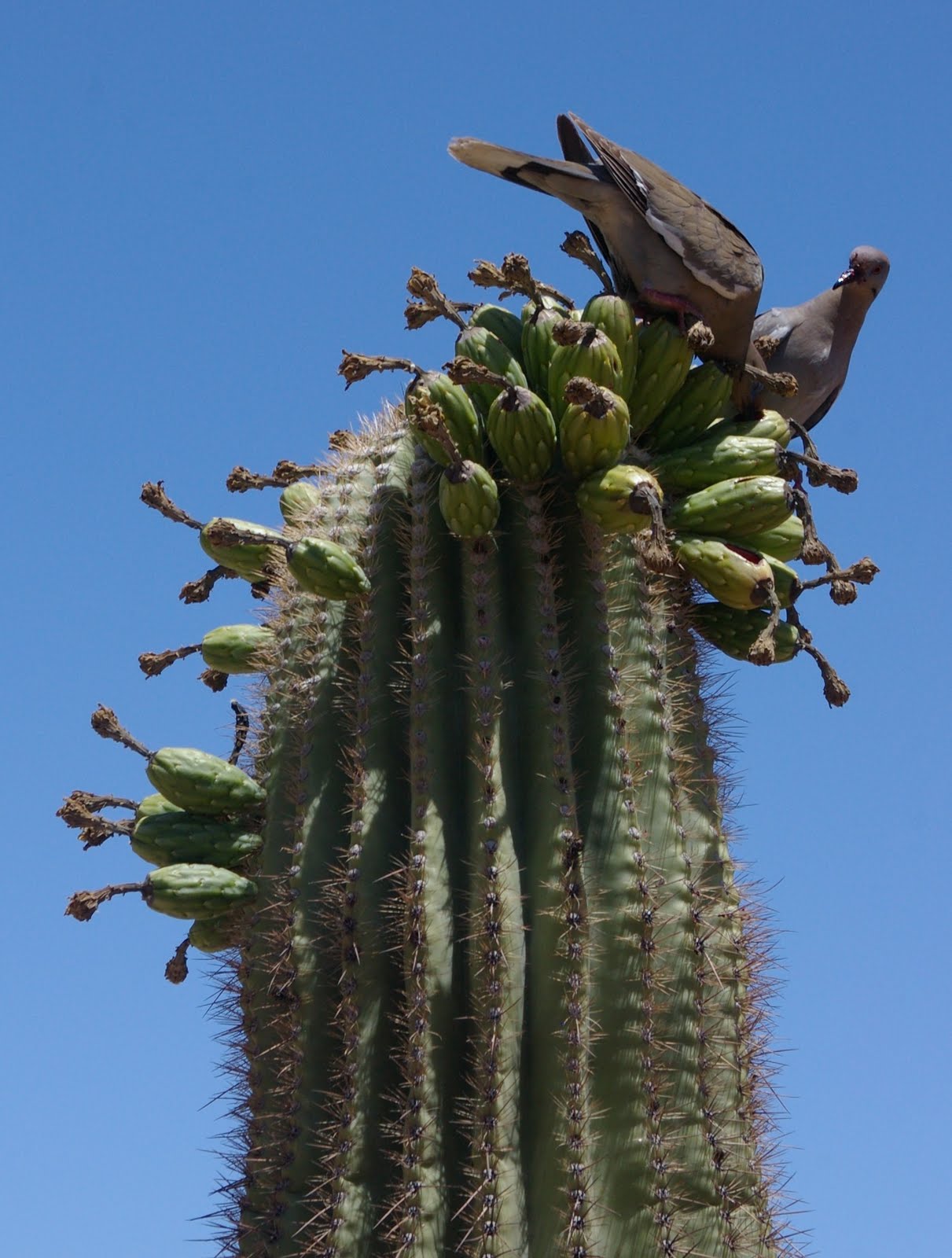
Shortly after the doves start opening holes in some of the earliest ripe fruit it is time to start gathering saguaro fruit.  Afternoon temps are often 105 (F) or more - in the shade - and there is usually little shade to be found.

The fruit need to be picked before the birds get to them and way before they open up like these.

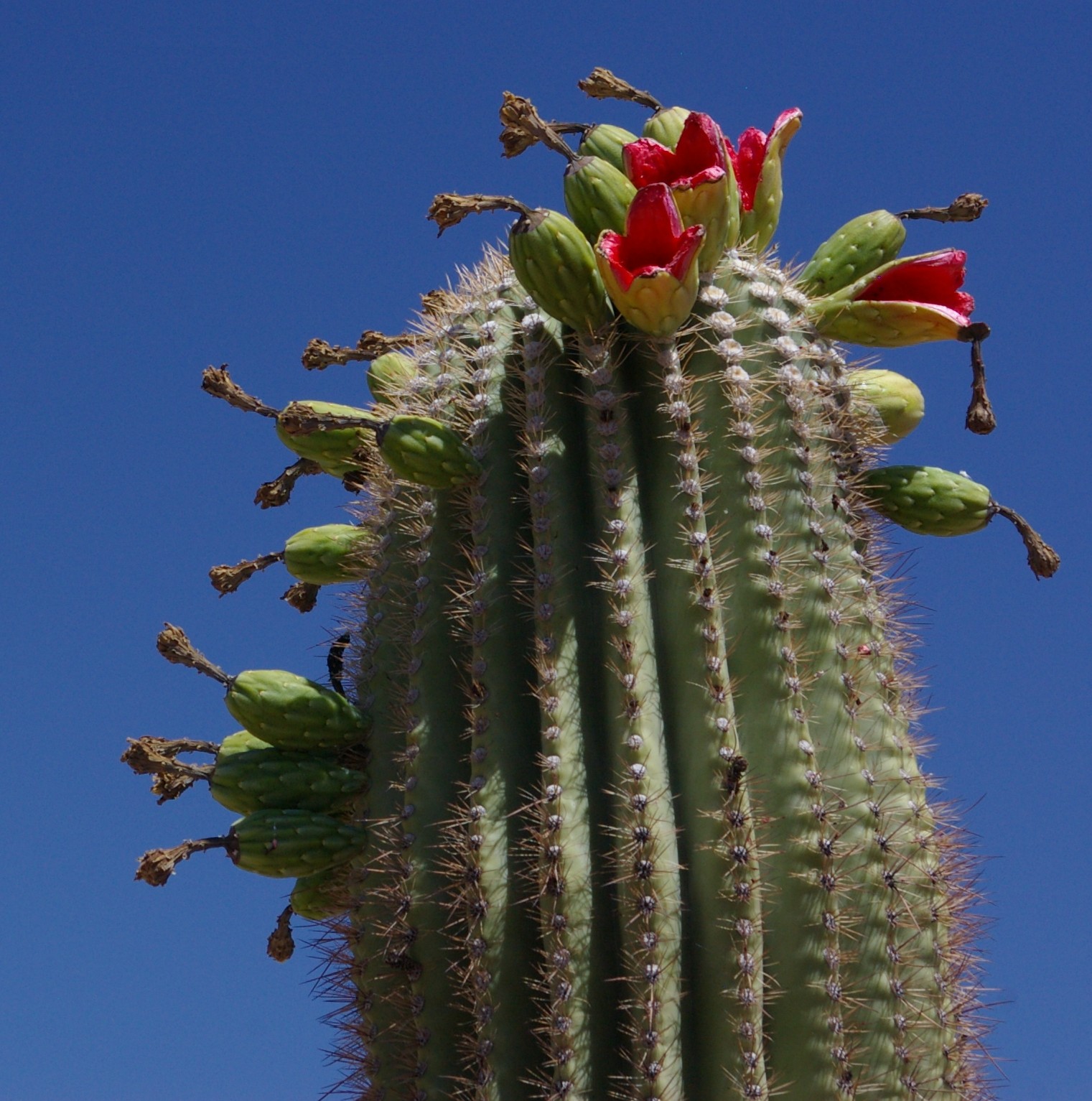
I look for a little pink or red at the tip and those are the ones I pick. Some saguaros have 4 or 5, some have 1 or 2 and many have none. 

The dried flower comes off easily and has a sharp edge to it.

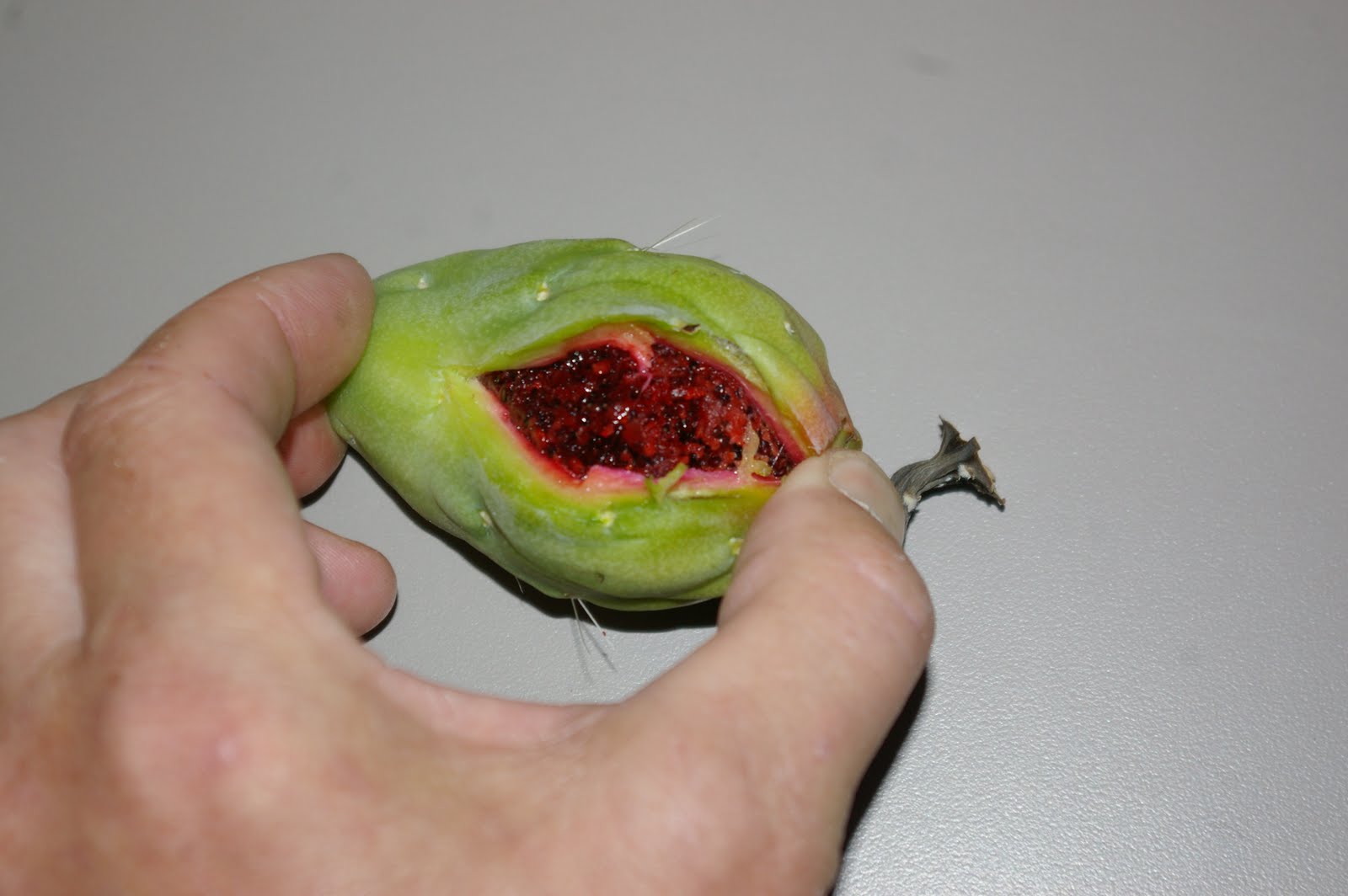
So sharp that it can be used to cut open the fruit.

The pulp inside is what I use. I cut the fruit (with a knife) and dig out the pulp with a thumb into a bowl.

When I have enough pulp, I can boil it down and remove some of the seed. This year I'm going to take out a few hundred seed first and see what I can get to grow later in the fall.

Ready? 4 cups saguaro fruit, 5 cups sugar, 1 packet of pectin.  That's my secret saguaro jam recipe. I may get a few batches this year...

Wednesday, May 12, 2010

Saguaro Blooms

The heat is near as the mighty saguaro cactus begins to bloom.

There will be two or three a day for some time. Keeps the bees busy!

And a close up. Most of the flowers are quite high so I try to take extra shots when they are lower.

I even found some saguaro fruit frozen in the back freezer, so I thawed it out and made some saguaro jam. Good stuff. The taste is very mild, almost a cross between strawberry and raspberry, but very much a watered-down version - not near as sweet.

Thursday, April 8, 2010

Saguaro Hotel

Holes are often found in saguaros. Some are good, some are bad, some are plain ugly. The nice, small generally pecked by woodpeckers or flickers making nests. Sometimes, starlings or other birds take over the hole the following year and sometimes they move right in!


But holes that are lower down aren't usually bird nests as they don't provide the same protection. Larger holes, same deal.  So how do they get there?
Rocks make holes in saguaros. Bullets do, too. Sometimes a cold snap will freeze tissue and later in the spring or summer a black ooze starts running down.  If the saguaro is healthy, it fights off the rot - otherwise it loses limbs or it dies.
At any rate, the saguaro scabs over any cuts, scrapes or holes providing a dry nesting place, but perhaps even more importantly, offers an evened out temperature range with cooler daytime temps and less nighttime temp loss. (temperatures can vary by 30 - 40 degrees F from night to day in the desert).