Showing posts with label wildflower. Show all posts

Wednesday, March 24, 2010

New Flowers

I may overdo it a bit in the spring with my flower pictures, but I almost always see new things or better shots or something to keep me coming back for more. This year, there are some different flowers among the old standards at the Desert Botanical Gardens.

Nice displays of color with the orange poppy, african violet and firecracker penstemon (all standard).


Nice mix of flowers & cactus (stabdard).


Firewheel flower (standard)


New - I don't know what it is.


Owl's Clover (standard)


Don't know, but I like it.


Don't know this one either, but I really like it!


A kind of paperflower?


A tiny cluster on a fairly good-sized shrub. I'm sure I've photographed this before, but I don't recall the pictures coming out so well.


I don't know if this one is new as much as there were so many more of them out this year. Nice ones.

Tuesday, April 14, 2009

Penstemon

There are quite a variety of penstemon out there and all will do fairly well out here in a landscaped setting, the only native here is the Perry's penstemon. (I think there is another desert native, but not found in our neck of the desert). In fact, perhaps because of the large leaves, you don't find many truly wild penstemon around.
Close up...a real hummingbird attraction.


Lupine

'You mean the flower lupine?' Sorry couldn't resist a bit of Monty Python humor. If you haven't seen it, you woldn't get it, but a very funny skit.

Anyhow, the flower lupine. Or Coulter's Lupine, if you prefer to be more exact. Grows very small unless well watered or in a nice shady spot (and fairly-well watered). Close up...a very interesting shape.
And ones well-watered. In the foreground are seed pods growing along the stems. The seeds look like pebbles; a good means of survival, I would think.

Monday, March 30, 2009

Rock Escheveria

A hike up South Mountain Park's Kiwanis Trail (and then across the road and up a short ways) will get you along side a few of these Escheverias. They aren't very big - the largest I saw was only about 4" across, though I have seen them something close to 8"

Flowers on stalks

Trailing 4 O'Clock

A hearty survivor, at least this particular plant, I have seen this flower over the years at pretty much the same place in South Mountain Park for well over 10 years. Obviously a low-lying plant with a small flower.
Closer up it looks as though the leaves are thick with dust, and that may be the case after the big winds we had last Thursday.

Tuesday, March 10, 2009

Brittlebush

Give them water and brittlebush can grow into a pretty large shrub, but normally it doesn't get much bigger than 3' x 3'. The flowers grow on long, thin stalks atop the plant. The flowers are some of the larger desert wildflowers and usually quite numerous on any given bush.

You can see how thin the stalks are here.

And a closer look:

Almost forgot to mention; the name 'brittlebush' is due to the brittle nature of the branches which snap off easily.

Sunday, March 8, 2009

Fiddleneck

There are other flower with a similar spiral, but they are usually somewhat smaller than the fiddleneck. The size varies from barely above ground to past the knee depending on location, rainfall and temperatures.
Tiny, yellow, trumpet-shaped flowers appear toward the top of the spiral which continues to unfurl as the plant grows. Hairy nettles appear on the stems, the leaves and the base of the flower (and eventually the seed casing). They help protect the plant from most predators - at least the larger ones.
A super-close shot.

Friday, March 6, 2009

Bursage

A member of the ragweed family, so if you have allergies, this is a nasty culprit. Usually about 1' - 2' high and up to 3' across. This one is heavy with blooms.
Here's a branch with a number of teeny, tiny flowers. You would hardly think such a small flower could produce anything to cause allergy problems. Allergens, perhaps, but problems? And the reason it is called bur-sage is the seed casing is a burr. There are a couple forming at the base of the branch. They trun brown and have velcro-like hooks that attach to animal fur or anything else brushing by.
Here is my hand after one tap from the branch above. I've walked in washes and come out with yellow pollen streaks on my pant legs.

Thursday, March 5, 2009

Desert Marigold

I decided it was high time to start using the close-up filters I had only previously used with print film. When the wind blew even the slightest amount I could never tell if my shot was in focus or not. Now with digital, I can tell right off if I need another shot.
So here are some shots of the desert marigold. The plant itself stands maybe a foot high with the flowers - maybe a bit more than that.

A close up of a 'normal' flower.


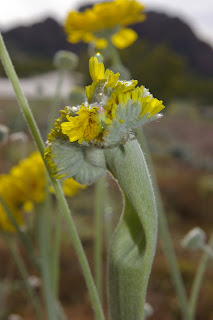
An aberrant form with a super-wide stalk and multiple flower heads. Check out the crab spider hiding on a petal.
Another aberrant with another crab spider