Sunday, March 8, 2009

Fiddleneck

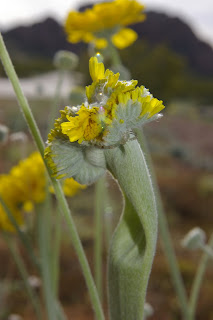
There are other flower with a similar spiral, but they are usually somewhat smaller than the fiddleneck. The size varies from barely above ground to past the knee depending on location, rainfall and temperatures.
Tiny, yellow, trumpet-shaped flowers appear toward the top of the spiral which continues to unfurl as the plant grows. Hairy nettles appear on the stems, the leaves and the base of the flower (and eventually the seed casing). They help protect the plant from most predators - at least the larger ones.
A super-close shot.

Teeny Critters

We'll start with this one, because the rest get a little better each time. I didn't see this one right away, and the tiny aphid I almost missed completely. The larger insect looking downward is a lacewing, I am pretty sure of that. It is smaller than most other lacewings I've seen, but they must grow from a smaller size to what I would term 'normal' size. Anyhow this one is about a third of 'normal' for green lacewings. They are helpful insects to have around as they tend to eat garden pests such as aphids. Lower middle of the picture you can make out the rear end of a lone aphid, probably about to become lunch.


I did my best to follow this tiny mite. Spider mite? The bright red made it easy to spot, even though it would barely cover the period at the end of this sentance, but would also fit inside the hole in the number8.

I don't know if it was trying to hide from me, but it was motionless as I first approached. Once I started trying to take pictures it started moving to the underside of the leaves and branches. With such a small range of focus, it took several attempts to get anything near decent. These are very tight crops of larger pictures to give you an indication of just how tiny this thing is.


I really don't know what type of fly this is, but it is very tiny. The middle part of the flower is maybe as big around a pencil eraser. The fly could easily fit inside a straw. Maybe someone with a little more background in bugwatching can help.


Here is the crab spider from the desert marigold picture a few posts ago. I cropped it tight in case it is too difficult to make out on the other post. This little guy could possibly stretch those long forelegs across my thumbnail.

Here is a good example of why lacewings and lady bugs are so helpful. One aphid isn't going to damage a healthy plant too terribly much. Take a large family of hungry aphids and allow them to raise their young and the plant isn't going to survive without some intervention. I thought these were flowers at first glance.

Friday, March 6, 2009

Bursage

A member of the ragweed family, so if you have allergies, this is a nasty culprit. Usually about 1' - 2' high and up to 3' across. This one is heavy with blooms.
Here's a branch with a number of teeny, tiny flowers. You would hardly think such a small flower could produce anything to cause allergy problems. Allergens, perhaps, but problems? And the reason it is called bur-sage is the seed casing is a burr. There are a couple forming at the base of the branch. They trun brown and have velcro-like hooks that attach to animal fur or anything else brushing by.
Here is my hand after one tap from the branch above. I've walked in washes and come out with yellow pollen streaks on my pant legs.

Another Globemallow

Not a lot of color variety just yet, but here's a pinkish one. I've seen them white, light-blue(ish), and very red besides the typical orange - light orange.

Thursday, March 5, 2009

Globemallow

Related to the marsh mallow, the globemallow is a common wildflower here. The neat thing about it is the variety of colors it can come in. I'll take some more pictures to show the various colors. This plant can get a bit over 3 feet high, but not usually much more than that.
Here are some branches with a bunch of globe-shaped flowers.
And here is a closer look

Desert Marigold

I decided it was high time to start using the close-up filters I had only previously used with print film. When the wind blew even the slightest amount I could never tell if my shot was in focus or not. Now with digital, I can tell right off if I need another shot.
So here are some shots of the desert marigold. The plant itself stands maybe a foot high with the flowers - maybe a bit more than that.

A close up of a 'normal' flower.


An aberrant form with a super-wide stalk and multiple flower heads. Check out the crab spider hiding on a petal.
Another aberrant with another crab spider

Wednesday, March 4, 2009

Happy Anniversary Al & Freddy - 45 yrs

Of course, that means they must have gotten married at age 13.
Goodness, how long have we known the VandeKamps? Must be almost 19 years now. We knew Lowell before we ever met them, but the year we were married we met Al & Freddy around Christmas time. They lived in our 'backyard' at the Hideout for a few months that spring.